

Close Menu
    Facebook X (Twitter) Instagram
    SciTechDaily
    • Biology
    • Chemistry
    • Earth
    • Health
    • Physics
    • Science
    • Space
    • Technology
    Facebook X (Twitter) Pinterest YouTube RSS
    SciTechDaily
    Home»Physics»Quantum Destabilization of a Water Sandwich – Laws of Classical Physics Break Down
    Physics

    Quantum Destabilization of a Water Sandwich – Laws of Classical Physics Break Down

    By King Abdullah University of Science & Technology (KAUST)November 3, 20191 Comment4 Mins Read
    Facebook Twitter Pinterest Telegram LinkedIn WhatsApp Email Reddit
    Share
    Facebook Twitter LinkedIn Pinterest Telegram Email Reddit
    Water Sandwich
    Measuring forces between hydrophobic surfaces at molecular resolution pin-points the contribution of the quantum nature of water’s hydrogen atoms to the hydrophobic interaction. Credit: 2019 KAUST; Xavier Pita

    When a thin layer of water is squeezed between two hydrophobic surfaces, the laws of classical physics break down.

    From raindrops rolling off the waxy surface of a waterlily leaf, to the efficiency of desalination membranes, interactions between water molecules and water-repellent “hydrophobic” surfaces are all around us. The interplay becomes even more intriguing when a thin water layer becomes sandwiched between two hydrophobic surfaces, KAUST researchers have shown.

    In the early 1980s, researchers first noted an unexpected effect when two hydrophobic surfaces were slowly brought together in water. “At some point, the two surfaces would suddenly jump into contact—like two magnets being brought together,” says Himanshu Mishra from KAUST’s Water Desalination and Reuse Center. Mishra’s lab investigates water at all length scales, from reducing water consumption in agriculture, to the properties of individual water molecules.

    Postdoc Dr. Buddha Shrestha at Work
    Buddha Shreshtha loads a silica disk with an ultrasmooth-surface terminated with perfluorocarbons comprising 10 carbon atoms. Credit: © 2019 KAUST

    Researchers were unable to explain the phenomenon at the molecular level, so in 2016, Mishra organized a KAUST conference on the subject. “We brought together leaders in the field—experimentalists and theorists—leading to intense debates on the understanding of hydrophobic surface forces,” he says.

    “This is very impressive work that shows how quantum nuclear effects in water become substantial on the nanoscale.” — Professor Mischa Bonn, director of the Max Planck Institute for Polymer Research

    Part of the challenge was that the hydrophobic interaction is unique to water. “Gaining insights through other liquids or adding cosolvents to water is not feasible: the interaction is dramatically reduced or lost,” explains Buddha Shrestha, a postdoctoral researcher in Mishra’s lab.
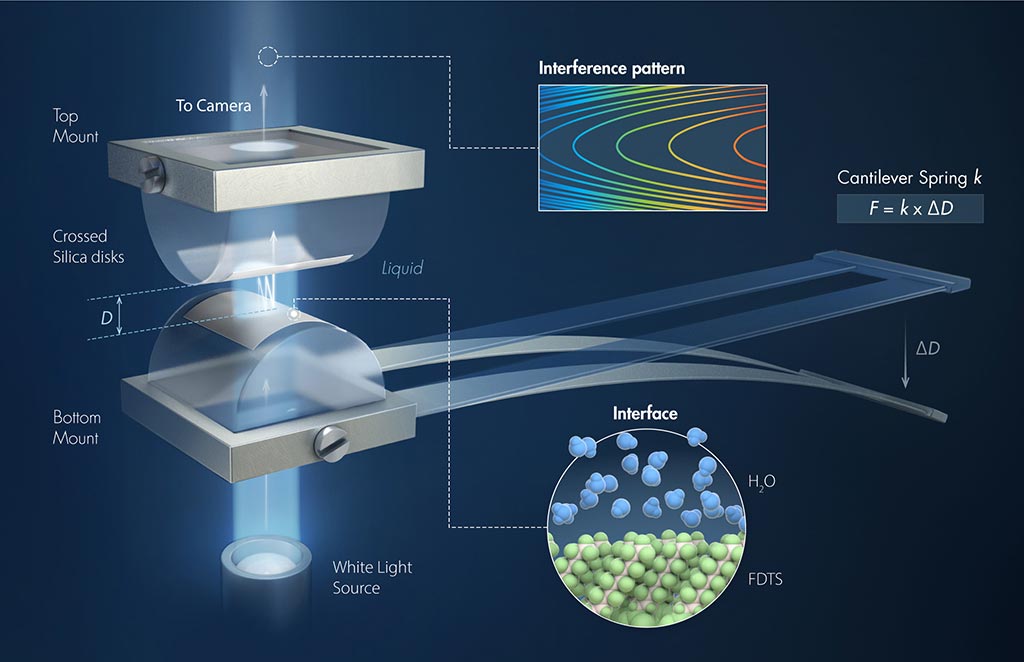
    Surface Force Apparatus
    The surface force apparatus permits a surface to approach or retract at an ultraslow speed toward the firmly secured second surface. Adhesion is measured by separating the surfaces upon contact. The inset depicts the water-perfluorocarbon interface. Credit: © 2019 KAUST; Xavier Pita

    Inspired by the conference, Mishra came up with the idea of comparing ordinary water with “heavy water,” in which the hydrogen atoms are replaced by a heavier hydrogen isotope called deuterium.

    “Our surface force measurements revealed that the attractive force was always approximately 10 percent higher in H2O than in D2O,” says Sreekiran Pillai, a Ph.D. student in Mishra’s lab. Collaborating with Tod Pascal at the University of California San Diego, the team came up with an explanation.
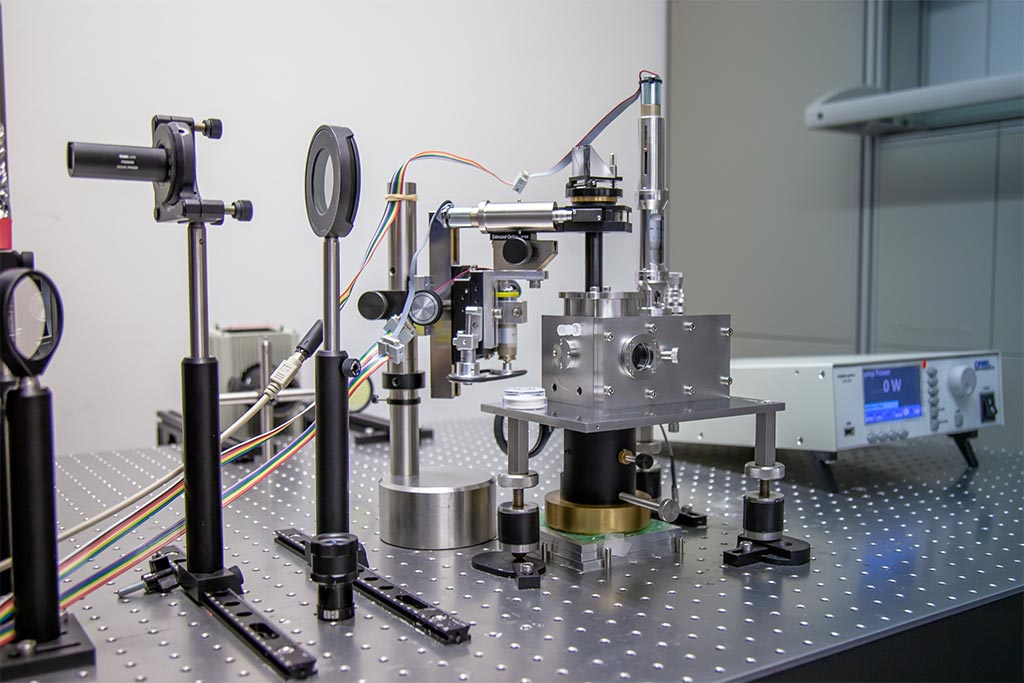
    Surface Force Apparatus Light Interference
    This surface force apparatus exploits light interference to resolve distances between ultrasmooth surfaces at an accuracy of 0.1 nanometers. Credit: © 2019 KAUST

    The smaller an object, the less strictly it is governed by the laws of classical physics and the more it is subject to quantum effects. A tiny hydrogen atom is a quantum object—sometimes behaving like a particle, sometimes more like a wave. Deuterium, twice as heavy as hydrogen, is less subject to quantum effects. The consequence is that D2O is less destabilized than H2O when squeezed between two hydrophobic surfaces and the hydrogen bonds between water molecules get broken.

    The discovery may have practical implications, Mishra says. “For example, these findings might aid the development of nanofluidic platforms for molecular separation.”

    Mishra Research Group
    Buddha Shreshtha (left) and Sreekiran Pillai (right) fine-tune the optics of the surface force apparatus as Himanshu Mishra observes. Credit: © 2019 KAUST

    “This is very impressive work that shows how quantum nuclear effects in water become substantial on the nanoscale,” explains Professor Mischa Bonn, director of the Max Planck Institute for Polymer Research. “The results illustrate that there is still much to learn about water at the fundamental level, yet with direct relevance to nanoscale-confined water in, for instance, nanopores used for water purification and desalination.”

    Reference: “Nuclear Quantum Effects in Hydrophobic Nanoconfinement” by Buddha Ratna Shrestha, Sreekiran Pillai, Adriano Santana, Stephen H. Donaldson Jr., Tod A. Pascal and Himanshu Mishra, 31 July 2019, Journal of Physical Chemistry Letters.
    DOI: 10.1021/acs.jpclett.9b01835

    Never miss a breakthrough: Join the SciTechDaily newsletter.
    Follow us on Google and Google News.

    KAUST Nanotechnology Popular Quantum Mechanics Water
    Share. Facebook Twitter Pinterest LinkedIn Email Reddit

    Related Articles

    At the Magic Angle, a Mysterious Vibration Emerges – And It Might Explain Superconductivity

    Water’s Hidden Side Revealed – It Can Exist in Two Liquid Forms at Once

    Scientists Just Found a Mind-Bending Way to Control Electrons

    Scientists Create Split-Electrons, Unlocking the Future of Quantum Computing

    Scientists Control Atoms With Light and It Could Change Chemistry and Physics Forever

    “Quantum Friction” Explains Fluid Dynamics Mystery That Has Baffled Scientists for 15 Years

    Quantum Computing Breakthrough: Exotic Quantum Particles – Less Magnetic Field Required

    Scientists Overhear Two Atoms Chatting: Magnetic Quantum Interactions

    Newly Discovered Phenomenon Shows Electrons Can Move Much Faster Than Expected

    1 Comment

    1. Laszlo LGM Meszaros on November 4, 2019 8:11 pm

      When we can’t explain something, we usually refer to the phrase “quantum effect”.

      Reply
    Leave A Reply Cancel Reply

    • Facebook
    • Twitter
    • Pinterest
    • YouTube

    Don't Miss a Discovery

    Subscribe for the Latest in Science & Tech!

    Trending News

    Artificial Sweeteners May Harm Future Generations, Study Suggests

    Splashdown! NASA Artemis II Returns From Record-Breaking Moon Mission

    What If Consciousness Exists Beyond Your Brain

    Scientists Finally Crack the 100-Million-Year Evolutionary Mystery of Squid and Cuttlefish

    Beyond “Safe Levels”: Study Challenges What We Know About Pesticides and Cancer

    Researchers Have Found a Dietary Compound That Increases Longevity

    Scientists Baffled by Bizarre “Living Fossil” From 275 Million Years Ago

    Your IQ at 23 Could Predict Your Wealth at 27, Study Finds

    Follow SciTechDaily
    • Facebook
    • Twitter
    • YouTube
    • Pinterest
    • Newsletter
    • RSS
    SciTech News
    • Biology News
    • Chemistry News
    • Earth News
    • Health News
    • Physics News
    • Science News
    • Space News
    • Technology News
    Recent Posts
    • Alzheimer’s Breakthrough: Scientists Discover Key Protein May Prevent Toxic Protein Clumps in the Brain
    • Scientists Discover New Way To Make Protein Shakes Taste Better
    • Scientists Break Optical Limits With Quantum Dot-Powered Nanoscopy
    • Scientists Shrink a Lab Spectrometer to the Size of a Grain of Sand
    • Quantum Reality Gets Stranger: Physicists Put a Lump of Metal in Two Places at Once
    Copyright © 1998 - 2026 SciTechDaily. All Rights Reserved.
    • Science News
    • About
    • Contact
    • Editorial Board
    • Privacy Policy
    • Terms of Use

    Type above and press Enter to search. Press Esc to cancel.